 Skip to content

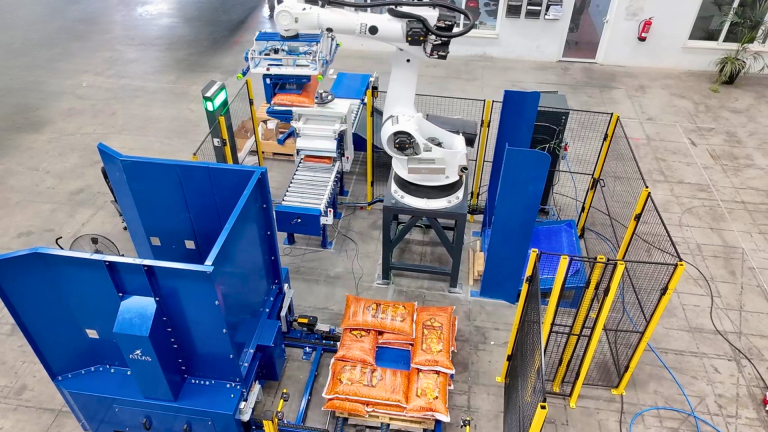
Table of Contents
A robotic bag-palletizing cell allows for three shifts to be operated at the labor cost of one, and pays for itself in 7 to 22 months, depending on the configuration and shifts. Doubling production on a bagging line without a robot requires hiring two additional workers, at a cost of €60,000 per year indefinitely; with a €50,000 cell, this can be done without hiring anyone, and the investment pays for itself in 11 months.
Here are all the calculations and assumptions, so you can recalculate them using your plant's numbers. At Atlas Robots , we've been manufacturing palletizing robots in Spain since 2015.
We'll calculate your payback period based on your shifts, your schedule, and your pace—with no obligation
The Starting Point
The calculations are based on a specific case, not on industry averages:
| Sector | Animal feed manufacturer |
|---|---|
| Application | Palletizing of bags at the end of the bagging line |
| Current Situation | 1 shift, 2 workers palletizing by hand |
| With the robotic cell | 1 operator per shift, supervising |
| Conference | 8 hours per shift, 220 days a year (1,760 hours per year per shift) |
| Cost of an employee to the company | 30,000 €/year (gross + Social Security) |
| Maintenance | 1,500 €/year for the contract + 300 €/year for parts and supplies |
| Electricity consumption | An average of 4 kW for consumption calculations, at 0.15 €/kWh; a peak of 13 kVA for sizing the service connection |
| Investment | Starting at €50,000 (ground-fed), €63,000 (automatic), €100,000 (high-speed) |
An important point to note: the cell does not, on its own, increase the line's speed. What it does is maintain the cadence hour after hour without tiring. Adding a second or third shift does not require doubling or tripling the palletizing staff. There's the return.
Clemente, manager of Pinturas Rodafuerte, explains this with the key statistic: a worker can produce six bags per minute at the start of the morning, but after two hours, he is tired and his actual pace drops to half that. The cell maintains that rate of six bags per minute throughout the entire workday.
ROI Formulas for a Palletizing Robot
Payback period (months) = Investment ÷ Annual net savings × 12
Annual net savings = Avoided labor costs − Maintenance − Replacement parts − Electricity
5-Year ROI (%) = (Annual Net Savings × 5 − Investment) ÷ Investment × 100
The avoided labor cost does not include the cost of workers who are already on staff. It is the cost of the workers who do not need to be hired in order to increase production.
Scenario A: Double production
The company wants to go from one shift to two.
- Without a robot: two more workers, one for each new shift. 60,000 €/year, for an indefinite period.
- With the cell: The two current operators each work one shift supervising the cell. No new hires. Annual cost of the robot: €1,500 for maintenance + €300 for replacement parts + €2,112 for electricity = 3,912 €/year.
- Net savings: 56,088 €/year.
For the €50,000 cell: 50,000 ÷ 56,088 × 12 = 11 months.
Scenario B: Triple production
The company wants to increase the number of shifts from one to three.
- Without a robot: four more workers. 120,000 €/year.
- With the cell: We need one more operator to cover the third shift. 30,000 € + 4,968 € for maintenance, replacement parts, and electricity = 34,968 €/year.
- Net savings: 85,032 €/year.
For the €50,000 cell: 50,000 ÷ 85,032 × 12 = 7 months.
How long does it take to pay for itself, depending on the configuration?
| Configuration | Investment | Double production | Triple production | 5-Year ROI (3 shifts) |
|---|---|---|---|---|
| Ground-level power supply | 50.000 € | 11 months | 7 months | 750 % |
| Automatic | 63.000 € | 14 months | 9 months | 575 % |
| High speed | 100.000 € | 22 months | 15 months | 325 % |
Labor Costs, Shift by Shift
It's the comparison that determines the investment:
| Production | Manual palletizing | With a robotic cell |
|---|---|---|
| 1 shift | 2 people · €60,000/year | 1 person · €30,000/year |
| 2 shifts | 4 people · 120,000 €/year | 2 people · €60,000/year |
| 3 shifts | 6 people · 180,000 €/year | 3 people · 90,000 €/year |
Tripling production with manual palletizing costs an additional €120,000 per year in labor costs—every year. With a robotic cell, it costs €35,000 in the first year and €5,000 in subsequent years, plus the initial investment.
A customer who has already set up this account
The accounts above are ours. This one isn't.
The company Pinturas Rodafuerte manufactures paint at La Roda (Albacete) and installed a bag palletizer from Atlas Robots on a refurbished industrial arm. Its manager explained it on camera:
"Over the course of a year or a year and a half, it has to pay for itself. And this robot does: it's already paid for itself."
Clemente, manager of Pinturas Rodafuerte
At the plant, production increased from 20–25 pallets per week to nearly 60, and the service—which previously took two or three days to process 10–15 pallets daily—was streamlined. The end-of-line station was not eliminated; the operator was reassigned to other production tasks.
Its duration—between twelve and eighteen months—falls within the range given in the calculations in this article. This is a case of palletizing sacks using a refurbished boom, just like the example calculated here. You can watch the full segment, including the unedited interview.
What's included in the price and what's extra
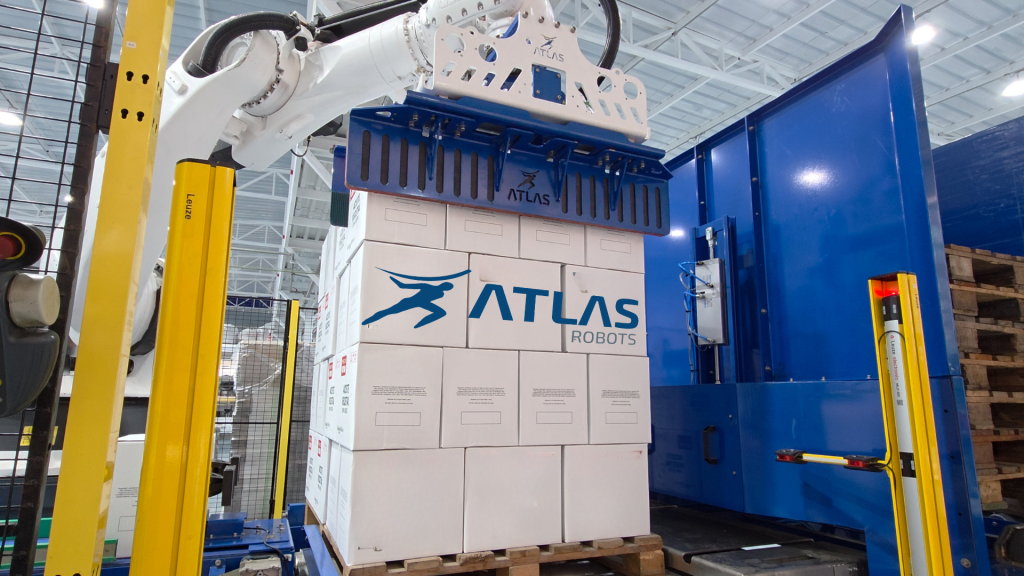
The price of a Atlas Robots cell includes a customized preliminary study, the refurbished KUKA robotic arm, the gripper, the perimeter fencing with optoelectronic barriers, the electrical panel and programming, the infeed conveyor, transportation and on-site installation, commissioning, staff training, CE marking with accompanying documentation, the warranty, and integration signals with the existing production line.
The customer is responsible for the electrical connection to the cell’s electrical panel, which is rated for a peak of 13 kVA. The standard cell measures 3 × 3 m and requires no civil engineering work or ground preparation.
Total cost of ownership over five years
| Initial investment | 63.000 € |
|---|---|
| Maintenance (5 × 1,500 €) | 7.500 € |
| Spare Parts and Supplies (5 × 300 €) | 1.500 € |
| Electricity (5 × 2,112 €) | 10.560 € |
| 5-Year TCO | 82.560 € |
| Personnel costs avoided over those 5 years | 300.000 € |
The arm has accumulated about 30,000 hours of operation at an automotive plant and has a mean time between failures of approximately 100,000 working hours. But what determines how long a cell lasts isn’t the number of hours—it’s the availability of replacement parts and maintenance. At Atlas Robots , we repair and replace whatever is necessary to keep the robot running, and each cell comes with its own preventive maintenance plan and spare parts list. Details on how we recondition each arm can be found at the process REFIT.
What Accelerates Return on Investment
- The shifts. It's the most important factor: it determines whether the investment pays off in 7 months or 22.
- The delivery. Installation takes about 3 months; savings begin as soon as the system is up and running, not when the contract is signed.
- Reliability. A machine that's not running doesn't save money. The €1,500/year maintenance contract includes preventive maintenance; materials are billed separately.
- The reconfiguration. Changing the bag format takes about 5 minutes using the HMI, so a change in the reference does not negate the day's savings.
What this calculation does not include
We have intentionally omitted savings from damaged bags, improperly assembled pallets, overtime, and absences due to physical strain, because we do not have those figures measured at the plant, and publishing estimates would undermine the credibility of the rest. All of these factors shorten the actual payback period.
Frequently Asked Questions About the ROI of a Palletizing Robot
How long does it take for a palletizing robot to pay for itself?
A €50,000 bag-palletizing cell pays for itself in 11 months if it doubles production without hiring additional staff, and in 7 months if it triples production by hiring just one person instead of four.
How much does a bag palletizing robot cost?
A Atlas Robots bag palletizing cell costs starting at €50,000 in a floor-feed configuration, approximately €63,000 in the automatic version, and approximately €100,000 in the high-speed version, with the arm, gripper, guardrails, electrical panel, installation, commissioning, training, and CE marking included.
Does a palletizing robot replace workers?
This is not the norm. Typically, a company retains its workforce and uses the cell to introduce new shifts: three shifts of manual palletizing require six people, whereas a robotic cell requires only three. At the Atlas Robots facility documented with the client, no positions were eliminated: end-of-line personnel were reassigned to other tasks within the same plant.
Are there any customers who have shared how long it took them to recoup the cost of their robot?
Yes. The manager of Pinturas Rodafuerte, a paint manufacturer at La Roda (Albacete), states in his interview that the cell paid for itself in one year or a year and a half, with production increasing from 20–25 pallets per week to nearly 60.
How many bags per minute can one person palletize?
A worker can handle about six bags per minute at the start of the shift, but the pace drops to about half that after two hours. A robotic cell maintains that rate throughout the entire shift.
How much does it cost to maintain a palletizing robot each year?
The maintenance contract costs €1,500 per year and includes preventive maintenance, but not materials. You’ll also need to add about €300 per year for replacement parts and supplies, and just over €1,000 for electricity for each shift worked.
How much electricity does a palletizing cell consume?
The cell has a peak power of 13 kVA, which is the power rating for which the service connection must be sized. Under normal operating conditions, it consumes about 4 kW, which amounts to just over 1,000 € in electricity costs per year per shift.
How long does it take to install a palletizing robot?
About 3 months from the order to commissioning at the plant.
Would you like a calculation based on your plant's specifications? Talk to our engineers.