Bag palletizer
from 50.000 €.
Palletizes 360 sacks or more per hour
Works with any format and size
Intuitive HMI screen and easy to use
Robustness and resistance for years
Automatic bag palletizer
High-efficiency robotic solution with universal mechanical grippers
Technical Specifications: Versatile robotic cell designed for the handling and palletizing of bags made of various materials (raffia, paper, plastic) without the risk of breakage. The system accommodates flexible loads ranging from 1 kg to 120 kg. Depending on production requirements, the cell can palletize from 360 bags per hour in the floor-feed version up to 1,000 bags per hour in the high-speed version. It features integrated high-precision mechanical grippers and intuitive HMI software that allows new palletizing patterns to be configured in just 5 minutes using coordinate tables.
Boost your production with our bag palletizing robot. With a speed of up to 360 bags per hour, it stacks bags onto pallets of various sizes with precision and efficiency.
Discover how the sack palletizer robot works
1
The robot is able to place an empty pallet in the initial loading position and, once completed, automatically replenish it. When the full pallet leaves the cell, the robot captures a new empty pallet and accurately positions it to start the next palletizing cycle.
2
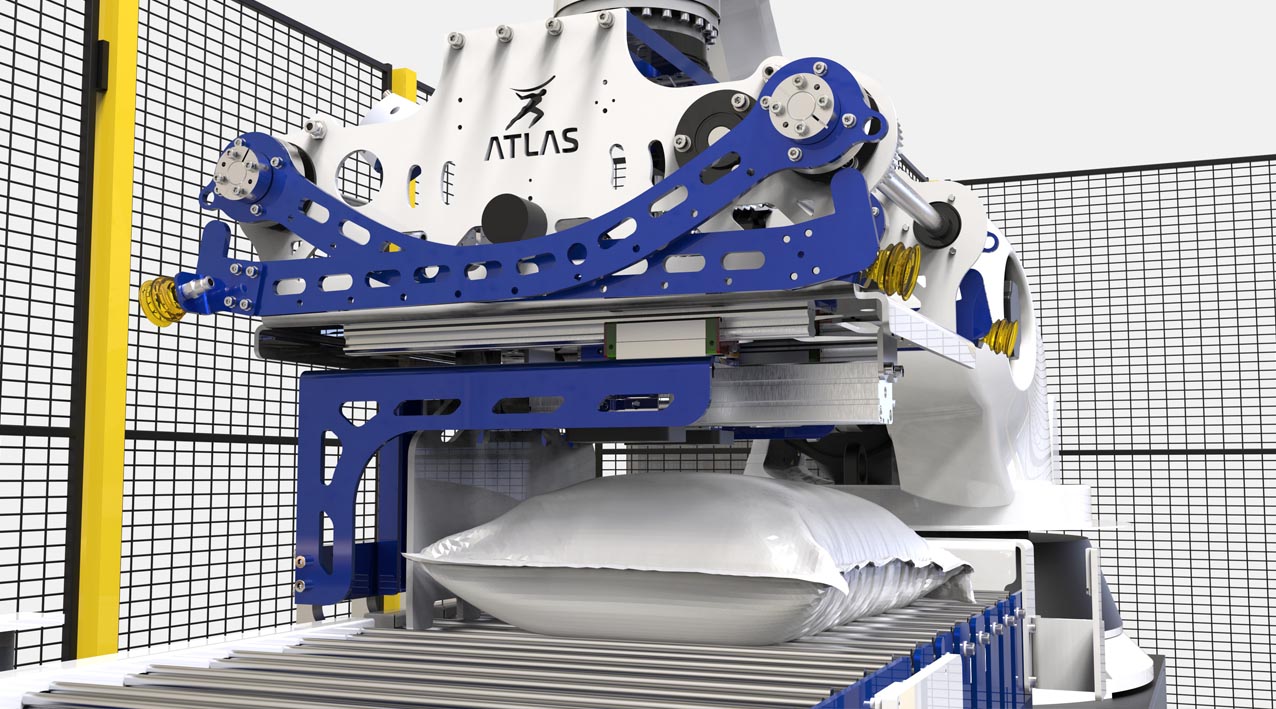
The bags enter the cell through a roller conveyor specially designed for their capture. They advance until they reach a stop at the end of the conveyor.
3
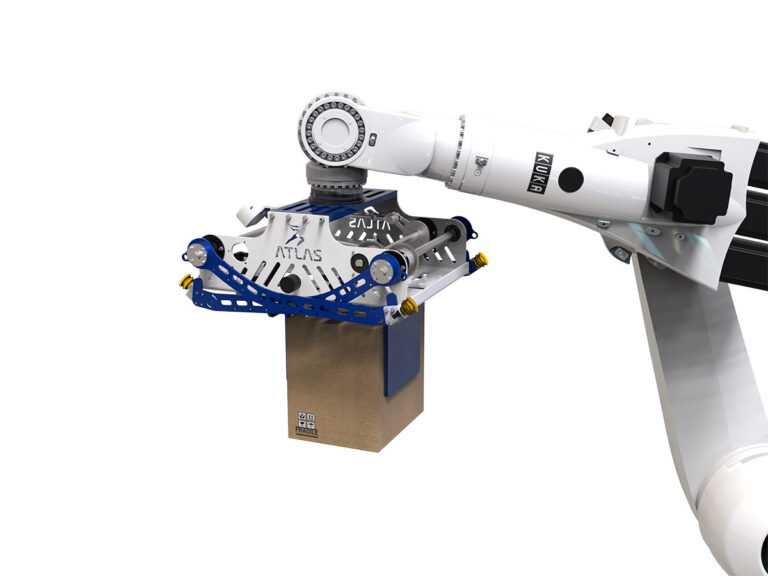
The robot is ready to capture the bag by inserting the gripper jaws into the slots on the side of the conveyor.
4
The robot positions the bag according to the mosaic predefined by programming. Once positioned, the gripper opens and releases the product into position. The process is repeated until the pallet is complete.
5
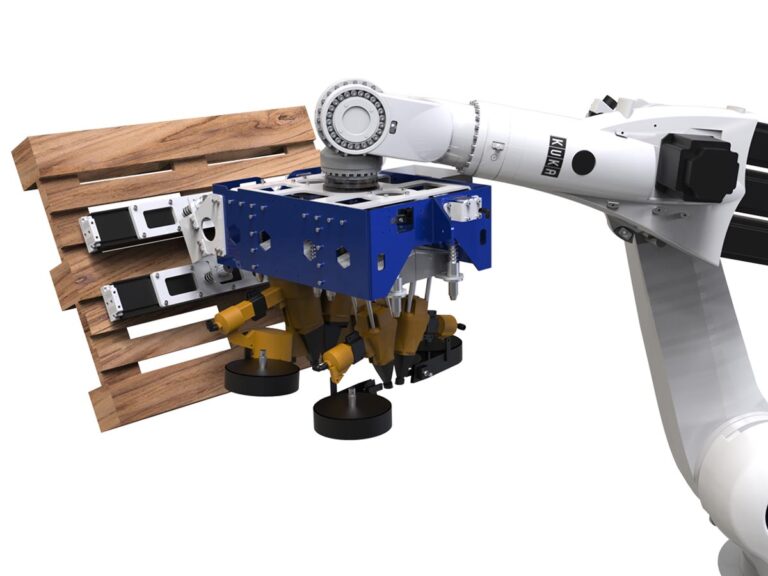
This installation has the option of capturing shelves from the magazine with its suction cup-equipped gripper and positions them precisely on the pallet on the conveyor to ensure greater stability.
Discover how the sack palletizer robot works

1
The robot is able to place an empty pallet in the initial loading position and, once completed, automatically replenish it. When the full pallet leaves the cell, the robot captures a new empty pallet and accurately positions it to start the next palletizing cycle.

2
The bags enter the cell through a roller conveyor specially designed for their capture. They advance until they reach a stop at the end of the conveyor.

3
The robot is ready to capture the bag by inserting the gripper jaws into the slots on the side of the conveyor.

4
The robot positions the bag according to the mosaic predefined by programming. Once positioned, the gripper opens and releases the product into position. The process is repeated until the pallet is complete.

5
This installation has the option of capturing shelves from the magazine with its suction cup-equipped gripper and positions them precisely on the pallet on the conveyor to ensure greater stability.
Explore the Robustness of Our Grips
The bag clamp uses claws and compression paddles to capture and place bags with precision. With electro-pneumatic grippers, it handles empty pallets, while its automated system secures bags with actuators. In pallet replenishment, it uses ultrasonic sensors and pneumatic grippers for agile and precise handling.
Do you have any questions?
Total Control and Remote Support at your Fingertips
Manage your system intuitively with our HMI display, which allows you to monitor alarms and statistics instantly. Thanks to advanced connectivity and remote diagnostics with integrated camera, you can solve problems quickly and minimize downtime.
Technology that optimizes every operation
Detailed Technical Specifications
| Technical Specifications | Details |
|---|---|
| Payload Range | 1 kg – 120 kg (Standard bag: 25 kg) |
| Capacity, floor-level version | 360 bags/hour |
| Capacity, high-speed version | 1,000 bags per hour |
| Claw Type | Universal Mechanics |
| Bag Compatibility | Raffia, paper, and plastic (No risk of breakage) |
| Input Lines | Up to 5 per robot |
| Maximum palletizing height | 2,700 mm (with pallet) |
| Pallet Sizes | European, American, English, box pallet, and half pallet |
| Robotic arm | 3,100 mm reach and 240 kg payload (typical configuration) |
| Protection | IP65 as standard, upgradeable to IP69K |
| Operating temperature | 5 to 40 °C |
| Cell surface area | 3 × 3 m (9 m²) |
| Reconfiguration time | 5 minutes per mosaic (via HMI) |
| Palletizing Patterns | 4 preset programs; capacity for 1,000, which the customer can create from the HMI |
| Preventive Maintenance | Lubricate every 3 years |
| Delivery Time | 3 months from the date the order was confirmed |
| On-site installation (quoted separately) | 1 week, with about 4 hours of training |
| Warranty | 1 year on parts (travel and technician hours not included) |
| Replacement Parts | Delivery within 24–48 hours |
| Price | Starting at €50,000 (ground level), €60,000 (automatic exit), €90,000 (high speed), and €115,000–130,000 (double). Excludes VAT, installation, and shipping. View detailed prices |
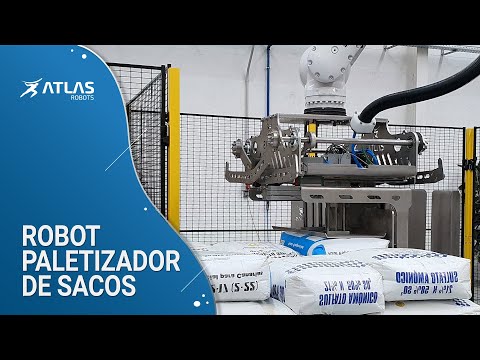
The bag palletizer in operation
Actual footage of the Atlas Robots bag palletizer in operation, filmed on the factory floor. More videos at the YouTube channel of Atlas Robots.
Standard palletizing: 2,800 bags in 8 hoursThe standard production version, at a rate of about 360 bags per hour.
Bag palletizer with automatic pallet dischargeOne of the two twin palletizers installed for Alimentos Cielo in Peru.
Potato bags with a pallet dispenser and bundlingComplete processing line for potatoes and onions, with a pallet dispenser and baling system.
Flour Bag Palletizer with Two RobotsDual configuration: two robots palletizing bags of flour in the same cell.
Stainless Steel Bag PalletizerStainless steel version for food-contact environments.
Palletizer for Bags of LegumesStandard cell palletizing bags of legumes at a rate of 6 bags per minute.
"It has improved my quality of life": a customer speaks outTestimonial from a customer who palletizes sacks of potatoes using a robot from Atlas Robots.
Frequently Asked Questions About the Bag Palletizer
Atlas Robots 's bag palletizer starts at €50,000 for the floor-feed version, €60,000 with automatic pallet discharge, and €90,000 for the high-speed version. Dual palletizers, equipped with two robots, cost between €115,000 and €130,000. These are factory-direct prices for the cell, excluding VAT, installation, and shipping.
Detailed pricing by configuration, extras, and annual costs · How it is amortized, with the complete financial statements.
All models include the robot, the gripper, the infeed conveyor, the control tower with HMI screen, the base, the guardrails, the safety devices, programming for 4 tiles, the manuals, and the CE marking. The floor-feed version palletizes onto two pallet positions on the floor. The automatic output version adds an output conveyor and a storage area for 9 empty pallets. The high-speed version features a faster robot and an automatic pallet dispenser.
A single robot from Atlas Robots can handle up to 5 input lines and distribute its throughput among them. When each line requires its own robot, the solution is a dual palletizer: €115,000 with a pallet storage system and €130,000 with an automatic pallet dispenser.
Installation, commissioning, transportation, and VAT are quoted separately. The customer is also responsible for providing electrical and compressed air connections to the unit. The installation does not require any civil engineering work.
The industrial robotic arm is always a refurbished unit from leading brands, which allows us to offer the cell starting at €50,000 with the reliability of a proven industrial robot. The custom gripper, safety features, and integration are designed and manufactured by Atlas Robots.
The same cell with a new, top-brand arm would cost about €100,000; with a reconditioned arm, the price starts at €50,000. The warranty covers parts for 1 year, replacement parts are delivered within 24–48 hours, and there are arms manufactured in 1995 that are still in production at the plant.
Here's what we'll tell you How We Refurbish Each Robot, Step by Step.
Yes, and it is covered by Atlas Robots. The robotic arm, on its own, is a quasi-machine: manufacturers supply it with a declaration of incorporation, not a CE marking, because its risk depends on its intended use.
By integrating it into a complete cell—with its gripper, fencing, light curtains, control panel, and safety logic—a new machine is brought to market. Atlas Robots acts as the manufacturer of this assembly: it conducts the risk assessment, prepares the technical documentation, and issues the EC Declaration of Conformity and the CE marking for the complete cell.
The machine comes with a declaration of conformity, operating and maintenance manuals, and electrical diagrams.
It handles bags weighing from 1 to 120 kg using the same universal mechanical gripper, with no risk of breakage, and adapts to any type of packaging: raffia, paper, or plastic.
It depends on the version: 360 bags per hour for the floor-feed model and up to 1,000 bags per hour for the high-speed model. A single robot can pick up bags from up to 5 input lines.
The standard cell occupies an area of 3 × 3 meters (9 m²), allowing it to be integrated into end-of-line areas with limited space.
The delivery time for a standard project is 3 months from the date the order is confirmed. Installation at the customer's facility—which is quoted separately—takes one week with two technicians and includes commissioning and approximately 4 hours of operator training.
Maintenance is limited to lubricating the shafts every 3 years. It also includes remote support and diagnostics, which reduce operating costs and downtime.