 Skip to content

Automating SMEs is no longer a futuristic option; it's a essential competitive strategy to optimize resources, improve quality, reduce costs and ensure sustainable growth increasingly demanding markets.
Process automation and the introduction of robots in the industrial setting are no longer a trend reserved solely for large corporations. Today, thanks to companies like Atlas Robots, the SMES can access solutions that completely transform their business. productivity, efficiency and ability to compete in increasingly demanding markets.
From palletizing robots for SMEs to advanced handling systems, the implementation of robotic technology is redefining the future of work, freeing employees from repetitive tasks and allowing them to focus on higher value-added activities. Below, we take a look at five key benefits of automating SMEs.
Want to learn more about Atlas SMB solutions?
1. Optimizes time: Increases productivity in SMEs
The most valuable, and often the scarcest, resource in an SME is the time. The process automation acts directly on this bottleneck by taking on repetitive, time-consuming or physically demanding tasks, freeing up thousands of man-hours per year.
The time optimization is one of the main drivers that push small and medium-sized companies to invest in the automation and industrial robotics. The ability to perform repetitive, physical or administrative tasks in an uninterrupted and accurate manner allows SMEs to significantly increase its productivity and free up resources for other strategic areas.
The key to this optimization lies in the capability of automated systems such as those of Atlas Robots for operate uninterrupted, 24 hours a day, 7 days a week, without fatigue or need for breaks. This translates directly into a significant increase in hourly and daily production. In addition, inherent consistency of robotic operation minimizes errors and reworkThis frees up resources that were previously allocated to bug fixes or constant monitoring.
How to eliminate repetitive tasks with process automation
The backbone of many industrial and logistics operations in SMEs is composed of monotonous, repetitive and often physically demanding tasks.
The process automation for SMEs robotics offers an effective solution to this challenge. Tasks such as moving pallets, palletizing bags or boxes, handling boards or heavy glass represent a logistical, physical and safety challenge when performed manually. The palletizing robots of Atlas can Handle loads with precision and constant speed without fatigue..
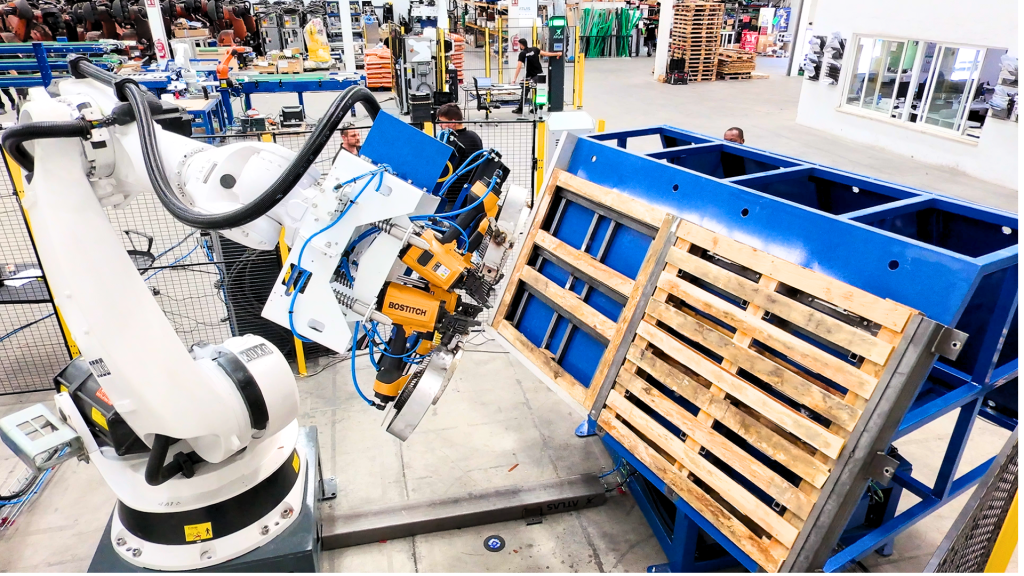
At Atlas Robots , we have developed compact robotic cells that can operating in confined spaces (3 × 3 m, about 9 m²), capable of palletizing all types of bags and boxes. This allows automate repetitive jobs such as the palletizing of bags or boxes with starting at 360 bags per hour.
This reorientation is not only beneficial to the company by optimize the use of your human capitalbut also boosts employee morale and satisfaction. By assigning them more challenging and meaningful taskswill professional development, increased commitment and a more dynamic and growth-oriented work culture are created.
2. Save money: automation in SMEs as a cost reduction strategy.
One of the strongest arguments in favor of automation for SMES is the significant reduction in operating costs. When a robot or automated system takes over routine tasks, it not only takes on eliminate cost overruns associated with errors, delays or stoppages, but are also associated with optimizes the consumption of resources and the use of materials.
By reducing costs, to obtain greater profitability becomes the main objective, and the robots for SMEs provide the necessary tool to achieve this objective. The initial investment in automation Typically, it is amortizes between 18 and 36 monthsdepending on the sector and scale of implementation.
The operational continuity provided by the Atlas industrial robots eliminate costs associated with unplanned downtime, work absences and variability in human performance. All this translates into a significant reduction of production times and, therefore, in a lower operating cost.
3. Standardized and error-free processes thanks to automation in small and medium-sized companies.
Standardization is the cornerstone of efficiency and quality in any production process. It allows to replicate results consistently, identify deviations quickly and apply improvements in a structured way. The automation for SMEs is the ideal tool to achieve process standardization that would be unattainable with human intervention alone.
Automation allows document and replicate processes accuratelycreating a organizational knowledge that transcends dependence on specific employees. This capability is particularly valuable for SMEs looking to scale operations or expand into new markets while maintaining consistent quality standards.
The benefits of standardization go beyond product consistency. They include the ability to predict production times with 98-99% accuracy, calculate accurate unit costs, plan preventive maintenance and establish objective performance metrics. This predictability is critical for SMEs that need to commit to specific deliverables and tight budgets.
Companies that implement robots for SMEsas the Atlas palletizing robotsThe new technologies are directly observing this improvement in standardization. A pallet, for example, will always be built with the same height, the same arrangement of boxes and the same stability, something that would be a constant challenge for the human workforce, especially under pressure or in long shifts. This consistency is vital not only for storage and transport, but also for the safety and professional image of the company.
4. A More Motivated Team: The Impact on Employee Satisfaction
Contrary to the initial concern that the automation for SMEs could dehumanize work or create unemployment, the reality is that, when implemented correctly, it can have a positive impact on employee morale and satisfaction. By freeing people from the most tedious, dangerous and repetitive tasks, it creates a more engaging and stimulating work environment.
Repetitive, physically hard or intellectually unchallenging tasks are the main causes of:
- Demotivation and DisconnectionMonotony extinguishes enthusiasm.
- Burnout SyndromeChronic stress due to constant physical or mental overload.
- Repetitive Strain Injuries (RSI) / Musculoskeletal Disorders (MSD)Direct and painful physical consequences.
- High turnoverEmployees are looking for less strenuous or more stimulating jobs.
Successful automation implementation requires a customer-centric approach. human capital development. Companies that invest in training and strategic relocation of employees see increases in job satisfaction of 40-60%.mainly due to the transition to more complex roles challenging and interesting.
Transitioning to more strategic roles also provides opportunities for the development of new competencies. Employees can specializing in areas such as robotic maintenance, data analysis, process optimization or product development, enhancing your professional value and career prospects.
In summary, automate SMEs is a smart strategy that benefits both the company and its employees. By redefining roles and offering opportunities for growth, you build a more competent, engaged and happier team, which is invaluable to any business.
5. Automating SMEs for the future: Scalability and sustainable growth.
Growth is the goal of every SME, but uncontrolled or inefficient growth can create more problems than solutions. Automating the SMEs with robots not only optimizes current operations, but also lays the groundwork for a new sustainable growth and a scalability unprecedented. The ability to adapt quickly to market fluctuations and increasing production demands is a key differentiator in today's business environment.
One of the major advantages of the implementation of robots for SMEs is the flexibility they offer to scale production. When a company grows and demand for its products increases, the traditional response would involve hiring more personnel, acquiring more machinery and expanding facilities. This process can be costly, time-consuming and sometimes non-linear in its efficiency.
With automation, the scalability is considerably simplified:
- Capacity expansion without high fixed costsAn automated production line can increase its work rate or add additional shifts without incurring the same incremental labor costs as with human personnel. The investment in robotic solutions such as a palletizing robot is a fixed cost that is diluted as production increases.
- Production flexibilityAtlas robotic systems can be programmed to handle different products or process variations. This allows SMEs to quickly adapt to new market demands or diversification of their offerings without the need for major restructuring.
- Opening of less expensive production lines: As mentioned, investment in automation—though significant initially—allows companies to set up new production lines or expand existing ones with a lower operating cost footprint. A palletizing robot for SMEs, for example, can replace the work of several operators on a new line, allowing that line to be profitable with a lower production volume than a manual line would require. At Atlas Robots , we design modular solutions that allow SMEs to add automation capacity gradually, as their needs and resources permit.
- Quality consistency on a large scaleAs production increases, maintaining consistent quality becomes more challenging with manual methods. Automation ensures that quality is not compromised, regardless of volume, which is crucial to maintaining customer satisfaction and brand reputation.
- Access to new marketsThe ability to produce on a larger scale and with greater efficiency can open doors to new markets, both domestic and international, that were previously out of reach for SMEs due to capacity or cost constraints.
- Competitive advantageSMEs that adopt automation early position themselves at a competitive advantage over those that do not. They can offer higher quality products at more competitive prices and with faster lead times.
The sustainable growth it's not just about increasing sales, but doing so in a way that is efficient, cost-effective and does not strain the company's resources. Automating SMEs facilitates this type of growth by enabling companies to scale their operations in a controlled manner, optimizing resources and maximizing profitability every step of the way. It is a strategic investment that ensures long-term viability and the SME's ability to adapt and thrive in an ever-changing business environment.