 Skip to content

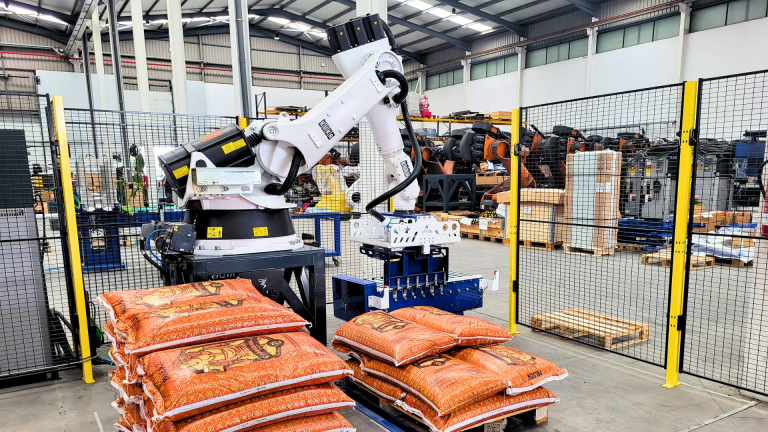
The bagging robot from Atlas Robots represents a revolution in the industrial end-of-line automationradically transforming the way companies manage their packaging and distribution processes. In an increasingly competitive global marketplace, where the operating efficiency and the reduction in costs are determining factors for business success, these factors are robotic systems emerge as the most advanced technological solution for the automated palletizing of bagged products.
These systems are not simply mechanical arms; they are advanced engineering solutions designed to operate in a manner uninterruptedwith a accuracy and a resistance that far exceed human capacity. For any company handling a considerable volume of bags, whether in the food processing industry, or in the construction, agri-food, chemical or of animal feed, etc...
Discover the bag palletizing robots designed by Atlas
What exactly is a palletizing robot and how does it work?
A palletizing robot is a automated system, industrial y software-controlledwhose main task is to collect products (in this case, sacks), and stack them on pallets by following predefined patternswith speed y accuracy.
Specifically -when we talk about a bagging robot- we are facing a robotic cell specifically designed to take bags (from 1 to 120 kg or more), place them on empty pallets, repeat the process layer after layerand deliver finished pallets ready for shipment.
The basic process can be divided into the following phases:
- Receipt of productThe products arrive at the robot through a system of conveyors.
- GripThe robot, programmed for a specific type of product and pattern, picks up the product by its arm y specialized gripping tools (tweezers, suction cups, etc...).
- Placement: The palletizing robot arm place the product with high precision on the pallet following the established pattern.
- ExpeditionOnce the pallet is complete, it is removed (in some cases, the pallet is automatically) and the cycle restarts for maximizing efficiency.
This entire process is controlled by a PLC (Programmable Logic Controller) which acts as the cell brainsynchronizing the robotthe conveyorsthe sensors and the safety systems.
The process of palletization follow predefined stacking patternscalled mosaicswhich optimize pallet stability y maximize space utilization. The robot automatically leaves the load on the exact position where it should be deposited.
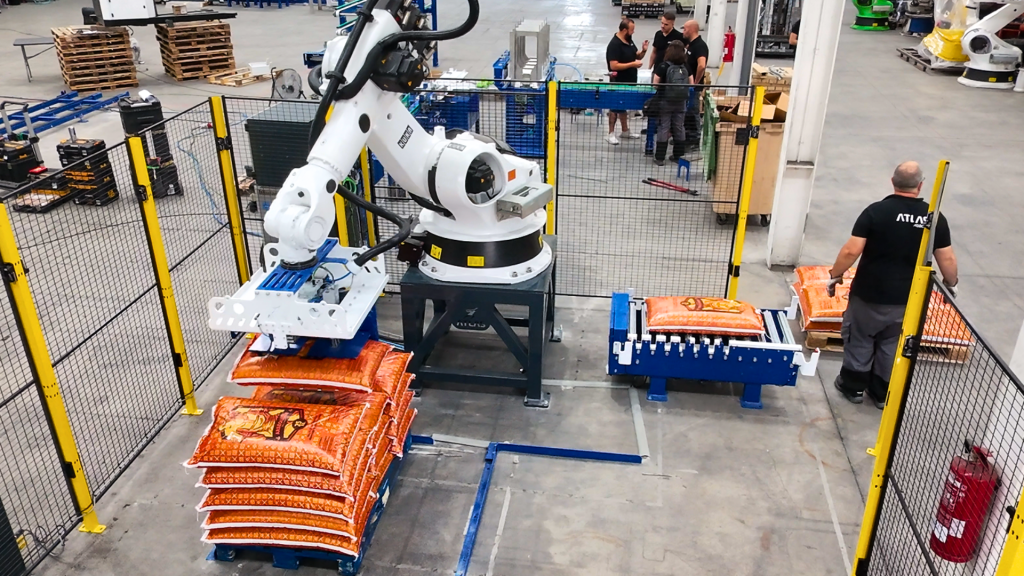
Key components of a robotized palletizing cell: robot, gripper, conveyors, safety...
One robotic palletizing cell constitutes a complex technological ecosystem that integrates multiple specialized components working in perfect synchrony for automate your production. The modular design of these systems allows adapt to specific needs of each industrial applicationensuring a optimum integration in the existing production lines. Among its components, the following stand out:
- Robot (robotic arm): usually with 4 or 6 axes, it allows complex and precise movements (tilting, rotating, moving).
- Input and output conveyorsThe palletizers: they carry bags to the loading area and pallets to the outside after loading, synchronizing the production flow.
- Automatic pallet dispenserempty pallets in the loading area and removes the finished pallets.
- Clamping systems (clamps/grippers/suction cups)Sack grabbers: specifically designed to capture sacks. They can use compression grippers, suction cups, or precision electro-pneumatic elements for different weights and formats.
- HMI screenIntuitive interface for the operator to program patterns, change settings or adjust cadences.
- Safety devicesThe system includes: fences, photoelectric sensors, ultrasonic detectors and automatic braking in case of human intrusion or anomalies.
- Control and programming software: pattern management (mosaics), cadences, integration with ERP/SCADA, or real-time remote monitoring.
Types of palletizing robots: Which one suits your product?
There are several types of Atlas palletizing robots adapted to a variety of products and industrial needs. The most common include:
- Bag palletizing robotsSpecialized in handling bags of different materials and weights. Its claws are designed to secure and position heavy bags or difficult to grip, ensuring a stable stacking.
- Case palletizing robotsEquipped with grippers adapted to different box formats and dimensionshighlighting in high volume production lines and sustained rhythm.
- Board handling robotsSpecific for the management of boards of different materials like wood, DM, melamineamong others. They are in charge of move, sort y stack these boards with large accuracy.
- Pallet sortersThese robots are in charge of organizing and sorting pallets according to their status (vacuum, full, type of materialetc.), automating the inflow and outflow of the pallets in the production line.
The Atlas bag palletizing robot is distinguished by the robustness of its claw or gripperthe sensitivity for handling bags with dusty, granular or other materials that require special treatment, and for the ability to accommodate heavy weights without damaging the products or compromising the pallet stability. The flexibility of these systems allows you to adapt the configuration for the handling of different sizes and weightsoptimizing the mosaics for each production process.
The importance of the gripper: Specialization for palletizing bags
The clamp or claw is a critical component on the performance of the bagging robot. Your specialized design allows:
- Grab bags of different materials (paper, plastic, raffia) and weights -many higher than 25 kg- without deform or damage them.
- Incorporate compression mechanisms, shovels y claws that guarantee a firm and secure hold even in bags that are not very compact or have irregular edges.
- Manage the precise and controlled placement of the sack on the pallet, keeping the correct orientation and allowing the formation of stable mosaics.
- Adapt the grip strength and the movements to handle both individual bags like groupsfacilitating the increased throughput and productivity.
In addition, some grippers allow the handling of cardboard interleaves between layers, improving the overall stability of the palletThis is especially relevant for products that are sensitive to deformation or require careful handling.
Competitive advantages of installing a bag palletizing robot
The decision to automate the end of the line with a robot palletizer for bags of Atlas Robots It is a high-return strategic investment that generates a significant return on investment. tangible benefits and measurable in the most critical areas of the company: productivity, safety, quality and operating costs. Adopting this technology is not an expense, but a decisive step towards the efficiency, resilience and market leadership. Below, we break down the transformative impact of this solution.
The most immediate and dramatic benefit is the exponential increase in productivity. A palletizing robot arm is designed to be the tireless engine of your production line. Unlike manual labor, which is limited by fatigue, shifts and physical capacity, a robot operates from uninterrupted 24 hours a day, 7 days a weekmaintaining a constant and predictable cadence.
While an experienced operator can handle, under optimal conditions, between 3 and 5 bags per minute (with a throughput that inevitably decreases throughout the day), a robotic system maintains a constant speed throughout the entire work shift. This translates into an ability to ship more product in less time, eliminate bottlenecks and improve efficiency.
In parallel, automation generates a revolution in occupational safety and team welfare. Manual handling of bags, which can weigh up to 120 kg, is one of the leading causes of musculoskeletal disorders (MSDs) in industrial settings, according to numerous occupational health agencies. Lower back pain, herniated discs, and injuries to the shoulders and wrists are, unfortunately, common. These injuries are not only a personal tragedy for the worker but also entail very high direct and indirect costs for the company: sick leave, increased insurance premiums, replacement costs, and an inevitable decline in team morale.
Reduces injuries with a bag palletizing robot
A palletizing robot for companies, as those who Atlas Robots eradicates this type of ergonomic risk at its root. Investment in automation is directly reflected in a drastic reduction in accident rates. This allows operators to be reassigned, freeing them from repetitive and strenuous tasks, to take on more value-added roles such as line supervision, quality control, programming or system maintenance, encouraging their professional development and commitment to the company.
Finally, the impact on the quality and consistency of the final product is absolute.. Human variability, due to fatigue or distraction, leads to irregular, unstable pallets and poorly positioned bags. A robot, on the other hand, executes the programmed palletizing mosaic with millimetric precision, cycle after cycle. Each bag is deposited at its exact coordinate, with the perfect orientation, creating compact, stable and visually flawless unit loads. This robotic consistency translates into direct logistical and economic benefits:
- Drastic reduction of wastage: Stable pallets minimize the risk of bags falling and breaking during handling, storage and transport. Some industry studies estimate that robotic palletizing can reduce losses due to damaged product by up to 90%.
- Optimization of storage and transportation: Uniform and compact pallets allow for safer and higher stacking, maximizing the use of vertical space in the warehouse. They also optimize truck loading, reducing logistics costs.
- Improved brand image: The delivery of perfectly constructed pallets projects an image of professionalism, quality and reliability to the customer, strengthening the business relationship and the company's reputation in the market.
Factors to consider before choosing your robot palletizer
Selecting the right palletizing robot requires analyzing several technical and operational variables to maximize return on investment and successful integration into the production line:
Necessary cadence, mosaics and integration
- Production rate: Determine the type and model of robot and gripper required. It is essential to adjust the system capacity to the production peaks to avoid bottlenecks.
- Mosaic and stacking patterns: Advanced software will allow programming different patterns, optimizing pallet space and stability according to bag type and logistical constraints.
- Integration with existing systems: It is important to ensure the compatibility of the new robots with the plant's conveyors, packaging systems, automated warehouses and ERP or control equipment.
- Available space and cell configuration: A compact cell can be essential in installations with limited space. Modularity allows the solution to scale as the company's needs grow.
- Maintainability and technical support: Choosing experienced suppliers like Atlas Robots that offer affordable replacement parts and technical support ensures operational continuity.
Schedule a meeting with our experts