 Skip to content

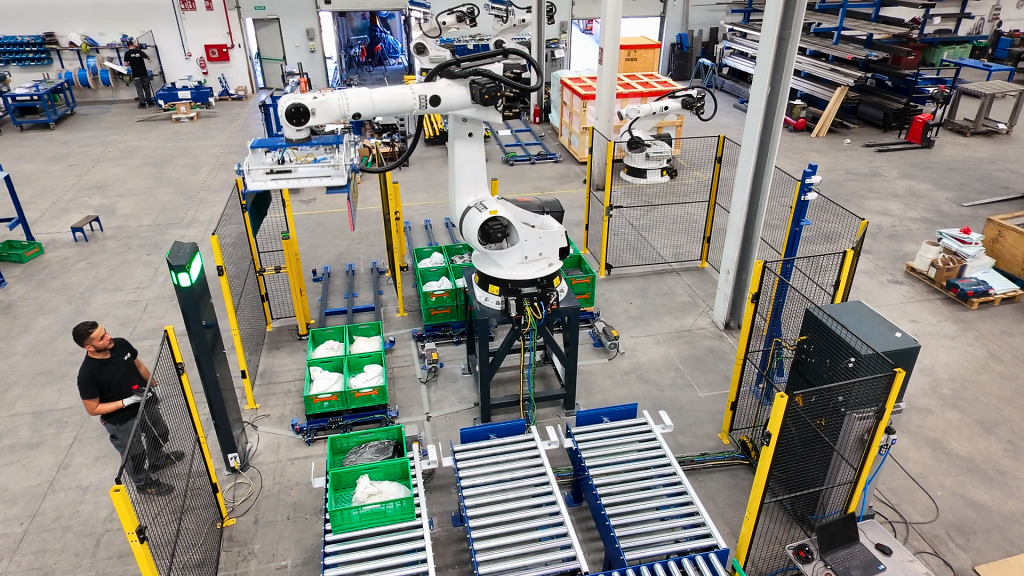
A case palletizer standardalso known as box palletizer o palletizing robot armis a automatic system -usually based on a industrial robotic arm- whose main function is to picking up boxes from the production conveyor and stacking them on a pallet according to predefined mosaic rules, optimizing space and ensuring stability. Below, we take a closer look at this concept, its applications, advantages, and how to choose the right solution, with a special focus on the models at Atlas Robots, which offer Fully customizable solutions that can be installed and commissioned in about 3 months.
Want to learn more about Atlas palletizing solutions?
What is a standard case palletizer?
A standard case palletizer is essentially a programmable robotic arm, part of a robotic cell, designed to receive boxes from the production line (such as modular conveyors or belts) and place them on an empty pallet, stacking them layer by layer according to a defined pattern. The robot incorporates a clamp with compression paddles, claws or suction cupsaccording to the type of box or product handled.
In addition, the system can:
- Automatically replenish empty pallets when the current pallet is full, and forward the full pallet for unloading.
- Integrate automatic conveyors such as modular belts, rollers, elevators or mobile tracks to serve several lines with a single robot.
- Include extra elements such as shelves or interlayers with suction cups to stabilize the load.
This type of robot is considered a autonomous robot or automatic palletizing robotwith the ability to work without constant supervision, adaptable configurations and high precision in each movement.
Why are case palletizers essential in modern industry?
Industrial automation is a mainstay in today's competitive industries, and within it, the standard case palletizing robots have become an indispensable element. Their integration offers multiple benefits that boost the efficiency and safety of operations:
- Reduced dependence on manual labor: These systems minimize repetitive and arduous work, which, in turn, minimizes significantly reduces the risk of injury for workers. By freeing operators from monotonous tasks, they are allowed to focus on higher value-added tasks, optimizing the company's human capital.
- Uninterrupted operation: Standard palletizing robots can work 24 hours a day, 7 days a week, with no breaks required. This ability to continuous operation is crucial for increase production and enable companies to respond effectively to peaks in demand without compromising quality or delivery times.
- Ease of use: Advances in technology have made robotic palletizing systems more highly intuitive. This means that they require a minimum training for operators. Management is often carried out through simple touch interfaces, which allows any operator, with no previous experience in robotics, can handle them..
In today's business environment, where the flexibility, efficiency and safety are determining factors for success, the automatic palletizing robot emerges as a strategic ally fundamental for any company that handles large volumes of product.
Benefits of using case palletizers in your logistics process
The integration of a standard crate palletizing robot offers a tangible and immediate improvement in any logistics or production process. The following are the most relevant benefits:
- Increased automation and productivity
Palletizing robots allow continuous processes by automating the loading of boxes onto pallets. This eliminates bottlenecks, facilitates the scalability to handle production peaks and improving automation in SMEs. In addition, its speed and precision are unmatched; a robot can handle large volumes of boxes per hour, ensuring perfect, uniform stacking that would be impossible for humans to replicate consistently.
- Reduction of operating costs
One of the most significant benefits is the labor savings. By reducing the need for operators dedicated to manual palletizing, it has a direct impact on personnel costs and expenses associated with injury or fatigue-related sick leave. It also achieves a better use of space thanks to optimized stacking patterns that minimize gaps and maximize the volume of the final palletizing, resulting in higher storage density.
- Improved delivery and quality of the final product
Robots guarantee a high gentle and controlled handling, which reduces the risk of damage to the boxes and the product during transport and stacking. This is achieved through precise motion control and advanced safety systems in standard case palletizers. The homogeneity in shipments is another key point; a well-shaped pallet facilitates transportation, reduces incidents and improves end-customer satisfaction.
- Relocation of operators to higher-value tasks
With the automation of palletizing, operators can be reassigned to higher value-added tasks. This includes roles in quality control, advanced logistics, supervision or maintenance, enabling them to contribute more significantly to the company's growth and competitiveness.
Standard Case Palletizers by Industry
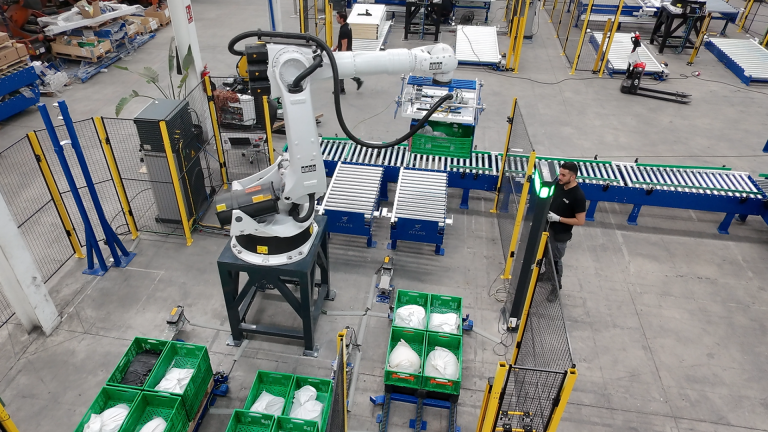
The versatility of standard case palletizersand in particular of the palletizing robot armsallows them to be a adaptable solution for a wide range of industries. Although the main function remains the same -stacking of products on pallets, the implementation and specific requirements vary considerably according to the sector.
Food and beverages
Handling of boxes and bottles of different formats for food, dairy, canned and soft drinks products.
Robots can handle crush-sensitive loads and ensure sanitary-compliant stacking.
Logistics and e-commerce
Automation of order picking and mixed pallet formation with boxes of different sizes, streamlining the management of warehouses and distribution centers.
Adaptability to frequent changes in packaging types and shipping flows.
Pharmaceuticals and cosmetics
Careful handling and fast positioning of containers and crates, avoiding contamination or damage to high value products.
Chemical industry and hazardous materials
Reduction of human contact with chemical or toxic products, improving occupational safety.
Construction materials and automotive sector
Palletizing of heavy parts and non-conventional formats, from boxes to blocks and loose parts.
Paper and printing industry
Handling of boxes of printed products, notebooks, catalogs or paper, respecting the integrity of the packaging.
In all of these industries, the key to success in the implementation of an palletizing robot lies in careful assessment of specific needs, selection of the right robot and end effector, and expert integration with existing systems. The flexibility and adaptability of the modern robotic systems ensure that there is an automated palletizing solution for almost any industrial application.
How to choose the right case palletizer?
The selection of the ideal case palletizer is a strategic decision that has a direct impact on the efficiency, cost-effectiveness and flexibility of your production line. The choice of solution depends on several factors factors specific to the operation. A Careful assessment of your current and future needs is crucial. to ensure a successful investment.
Product and case characteristics
- Dimensions (Length, Width, Height): Critical for robot reach and palletizing patterns.
- Weight of the boxes: Determines the required payload capacity of the robotic arm.
- Material and Stability of the Boxes: Influences the type of end effector (gripper) required, especially for unstable or slippery containers.
- Surface of the Boxes: It affects the choice of suction cups or tweezers.
Production volume and speed required
- Palletizing requirement per minute/hour, key to robot type and size.
- Consider seasonal peaks for maximum capacity.
Types and dimensions of pallets
- Compatibility with the type and dimensions of pallets (Euro, American, etc.) for optimal stacking.
- Flexibility to adapt to different types of pallets if necessary.
Available floor space
- Measure the area available for robot operation and maintenance, including reach and safety zones. The palletizing systems for standard boxes Atlas Robots are optimized for a reduced spatial footprint, equivalent to an operator's workstationmaximizing the efficiency of floor space.
Flexibility and future needs
- Consider product changes or palletizing patterns; look for intuitive programming software.
- Evaluate integration with other equipment (wrappers, bundlers, WMS).
Budget and return on investment (ROI)
- Define budget and calculate ROI based on labor savings, error reduction, increased productivity and improved safety.
At Atlas Robots we offer standard palletizing solutions that are completely adapted to your production needsThe accuracy to handle any type of box. Our standard case palletizers are of intuitive operability thanks to simple user interfaces that allow anyone to program or modify patterns quickly, reducing dependence on specialized personnel.
In addition, we guarantee the availability and competitive delivery times which facilitates an agile implementation and a quick return on investment for companies seeking to optimize their production line and increase their competitiveness.